As video game movies keep getting better (or at least more popular), a few blueprints have emerged for adapting material that used to consistently stump Hollywood. Some games flesh out their stories and mythologies so effectively that a faithful adaptation is all you need to deliver a hit (a category that includes everything from “The Last of Us” to “Super Mario Galaxy”). You can also find success at the other end of the spectrum: accept that a game’s story matters little and make an original film that captures the vibe of playing it (see: “Resident Evil”).
Kitao Sakurai’s new take on “Street Fighter” lands somewhere in between those two extremes, and while it doesn’t reap the full benefits of either approach, it delivers an unforgettable time at the movies. The film stays true to the games’ core storyline about Ryu (Andrew Koji) and Ken Masters (Noah Centineo), two martial artists who grew up together and try to protect each other from their demons as adults. But the viewing experience feels more like playing the arcade game, which asks nothing more of its audience than to scroll through a selection of cartoonish warrior characters and pick one to beat the shit out of another.

A quick glance at the ensemble cast is enough to simulate that feeling of flicking through a “Choose Your Fighter” screen. You have Jason Momoa doused in green CGI muscles; 50 Cent playing a Tyson-esque boxer with a hairline that’s more geometric than anything nature could produce on its own; WWE wrestlers Cody Rhodes and Roman Reigns; comedians from both sides of the political spectrum like Eric Andre and Andrew Schulz; gay music icon Orville Peck donning Wolverine-style claws; and appearances from David Dastmalchian and Kyle Mooney for good measure. Everyone can probably find someone they love and someone they hate in that cast, ensuring that nobody really knows what kind of roller coaster ride they’re in for when they buy a ticket.
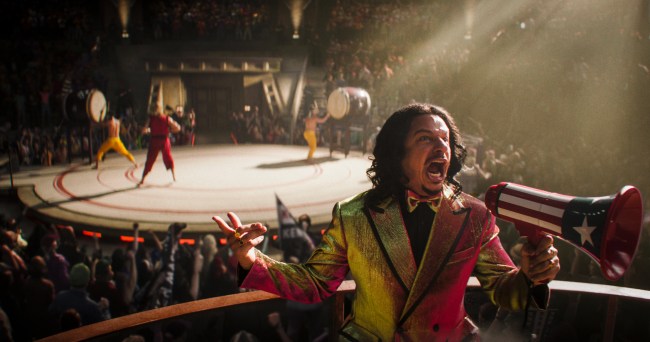
And what a roller coaster ride it is. By conventional storytelling standards, this take on “Street Fighter” is incoherent nonsense. Yet it rarely contains an image that fails to captivate, as Sakurai constantly bombards us with bright neon colors, surreal humor, classic rock needle drops, and costume design and hairstyling that are both admirably dedicated to recreating the two-dimensional arcade-game aesthetic. A cynic might describe “Street Fighter” as a film always designed to be chopped into meaningless clips, better suited to piecemeal consumption on Reels than to theatrical viewing. A more charitable interpretation would praise its massive visual swings and ordain it a misunderstood masterpiece of expressionism. But no matter where your opinion falls on that particular spectrum, the film seems destined to flop upon its initial release before being reclaimed as a cult classic over the next quarter century.
There’s only so much room for “Street Fighter” plot summary before you end up dancing about architecture, but here goes: Ryu and Ken are adopted brothers who grew up together and studied under the same master, who always warned them to protect each other from themselves. They both dreamed of fighting in the prestigious World Warrior Tournament, which assembles the best fighters from every discipline in a Kumite-esque bracket to determine who is the best. Ryu wins the first time, but the brothers have a falling out and start a beef with a demon named Akuna before going their separate ways. It leaves Ken brotherless and undisciplined, resting on his laurels and chasing cheap endorsement deals, before a second World Warrior Tournament is unexpectedly announced six years later.
At this point, we need to pause and take a deep breath before diving into the myriad of baffling creative choices that this movie makes. Ready? Every flashback sequence is fully animated, even though everything in the present is live-action. Most of the film centers on a martial arts tournament of 16 warriors, but more than half of the marquee fights end in offscreen forfeits before they even begin. All the street fighters spend far more time hanging out at the hotel bar or talking shit in the hallways than at the arena. Cody Rhodes, arguably the world’s most popular wrestler, never really fights in the movie — he spends most of his screen time sitting around spewing vaguely homoerotic insults like calling his enemies “titty boy” or seductively handing someone a Budweiser with the label facing out and daring them to “suck on this.” And the film inexplicably takes place in 1993, even though its authoritarian backdrop, where everyone’s ultimate goal is to land an endorsement deal for their own Taco Bell Gordita, feels as 2026 as you can get.
That barely scratches the surface of a film that overflows with convoluted plotting and confusingly engineered jokes. But a film’s greatest sin is boring its audience, and this “Street Fighter” should take pride in never coming close to doing that. Fans of the “Street Fighter” games don’t spend much time thinking about the overarching lore. The games are a flashy vessel to project yourself onto while you play with martial artists, each with their own unique aesthetics. And at the end of the day, this movie delivers the same thing. It’s a blank emotional canvas whose value lies in what you make of it — but it sure looks cool as hell.
Grade: B-
A Paramount release, “Street Fighter” opens in theaters on Friday, October 16.
