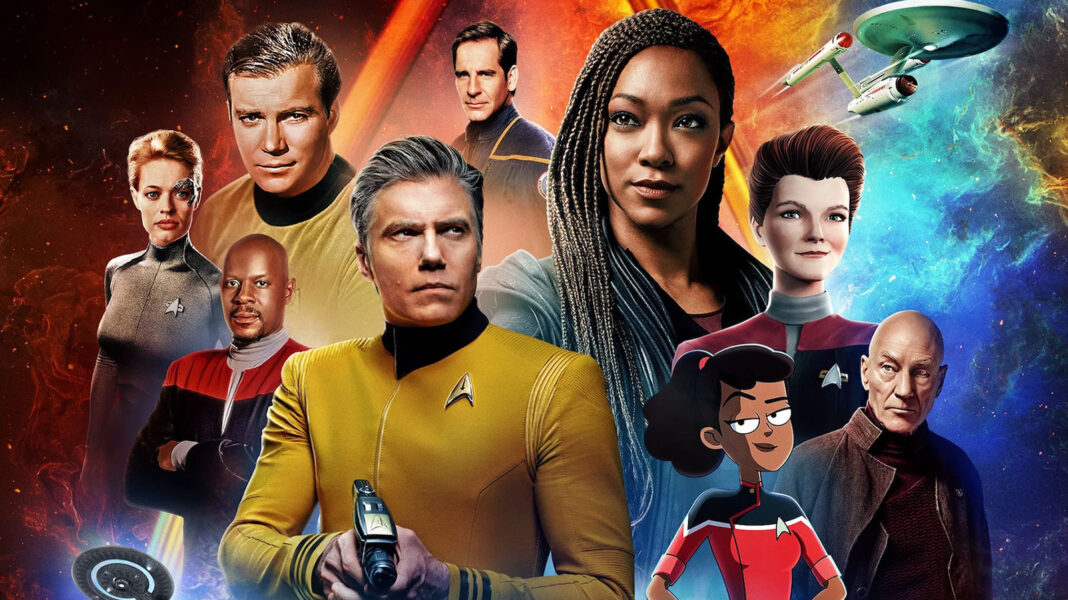
Six decades since its debut, “Star Trek” still reigns as the greatest sci-fi franchise of all time. Created by Gene Roddenberry, the original 1960s show eventually blossomed into a full-fledged phenomenon with multiple series, a line of feature films, and a mountain of merchandising. But there’s something about the franchise that just feels best suited for the television medium. Fortunately, there’s been over a dozen shows to underscore that distinction. Of course, while every series has its own vocal fanbase, the fact of the matter is that not every show is created equal.
After ranking the “Star Trek” movies by Rotten Tomatoes score, we’re taking a similar look at the franchise’s growing bench of television series. But to change things up, this time we’re looking at how each of the shows ranks according to user scores on IMDb. While scores are always subject to change, we’re going to include each of the show’s individual scores as they currently stand at the time of this writing.
Here are all 13 “Star Trek” TV shows ranked by IMDb from worst to best, representing the franchise’s television legacy.
13. Star Trek: Starfleet Academy (4.4)
Given unsurprising reports that “Starfleet Academy” has been review-bombed, it should similarly not come as a surprise that the 2026 series is at bottom of IMDb franchise ranking. The Paramount+ series takes place after the events of “Star Trek: Discovery” in the 32nd century as the Federation rebuilds itself. Overseeing the first class of Starfleet cadets in over a century is Nahla Ake (Holly Hunter), who leads the cadets from her starship, the USS Athena. Among the star pupils is Caleb Mir (Sandro Rosta), who shares a backstory with both Ake and the villainous Nus Braka (Paul Giamatti).
“Starfleet Academy” brings a young adult flavor to the franchise in the same way that the animated series “Prodigy” was for even younger audiences. There is plenty of teen drama and coming-of-age stakes all while set within the “Star Trek” universe and its burgeoning far-future. Hunter is excellent as always while the young cast is as eager and wide-eyed as their respective characters are intended to be. Cut short after a two-season run, “Star Trek: Starfleet Academy” just didn’t connect with fans to the level that Paramount+ had hoped.
12. Star Trek: Discovery (7.0)
After being off television for over a decade, the “Star Trek” franchise officially entered the streaming era with the 2017 series “Discovery.” A prequel to “The Original Series,” the show opens with the Federation going to war with the Klingon Empire. At the center of the conflict is the USS Discovery, a unique starship with disgraced officer Michael Burnham (Sonequa Martin-Green) among its crew. Later seasons have the Discovery transported to the far-future where it helps rebuild Starfleet following a cataclysmic incident known as the Burn.
“Star Trek: Discovery” had a wobbly start but significantly improves by its second season and coalesces further after its huge time jump. The series starts out as a more intense war show before becoming narrative about rediscovering hope at the end of time. Through it all are stellar performances from Martin-Green and Doug Jones, with the latter playing the Kelpian science officer Saru. Providing a modern rebirth for “Star Trek” on television, “Discovery” is a fun, if uneven, five-season ride.
11. Star Trek: Short Treks (7.1)
Initially spinning directly out of the events of “Discovery,” the 2018 series “Star Trek: Short Treks” experimented with the franchise’s usual storytelling format. True to its title, the show featured stories with truncated runtimes in mini-episodes about different characters in the franchise. This includes brief tales about Sylvia Tilly (Mary Wiseman) and Harry Mudd (Rainn Wilson) experiencing self-contained adventures. The second and final season expanded the scope of “Short Treks” to set up “Star Trek: Strange New Worlds” and “Star Trek: Picard.”
“Short Treks” is easily digestible by design, providing ancillary material involving fan-favorite characters in the Paramount+ era of the franchise. While many of these stories are inconsequential, the show does bring a more light-hearted touch to the franchise missing in the early seasons of “Discovery.” The format was revisited through an animated lens with the YouTube webisodes “Very Short Treks,” though these stories are largely considered non-canonical. An enjoyable set of appendices to the main shows, “Short Treks” lets fans spend a little more time with their favorite figures.
10. Star Trek: The Animated Series (7.2)
The “Star Trek” franchise’s expansion into animated television began in 1973 with “Star Trek: The Animated Series,” as it was retroactively titled. The show continued the adventures of the Enterprise and its crew from “The Original Series,” with most of the main cast reprising their roles. Captain James T. Kirk (William Shatner) leads his crew as they encounter all sorts of unknown marvels in the cosmos. Familiar faces from the preceding series occasionally resurfaced, including the Guardian of Forever, Harry Mudd (Roger C. Carmel), and even another incident with Tribbles.
Running for two seasons, “The Animated Series” became a forgotten spin-off worth revisiting over five decades later. While the limitations of the show’s production budget are often evident, it adds to the show’s charm in a nostalgically retro kind of way. Part of the show’s appeal is that it rarely played down to a younger audience, still featuring smart sci-fi storytelling in episodes like “Yesteryear” and “The Terratin Incident.” A fun extension of the “TOS” era, “The Animated Series” definitely is a must-watch for franchise fans.
9. Star Trek: Picard (7.5)
Nearly 20 years after the events of the 2002 movie “Star Trek: Nemesis,” the 2020 series “Star Trek: Picard” unveils the post-retirement activities of Jean-Luc Picard (Patrick Stewart). Resigning from Starfleet over their controversial handling of Romulan refugees, Picard settles in at his family’s vineyard in France. After uncovering a conspiracy involving Romulans and the Borg, Picard ventures back into the cosmos for new adventures. In the third and final season, Picard reunites with his old crew when the Borg and Changelings team up for a renewed effort to destroy the Federation.
Ironically, like “The Next Generation” before it, “Star Trek: Picard” doesn’t get good until its third season. The show’s second season is a marked improvement over the first, but those initial seasons never seem sure of what they really want to say. But with a welcome change in showrunners and reunion of the classic cast, “Picard” season 3 is the best “Next Generation” movie we never got. Despite a shaky start, like a lot of “Star Trek” shows, “Picard” sticks the landing and finally delivers what fans had hoped for all along.
8. Star Trek: Prodigy (7.6)
The 2021 animated series “Star Trek: Prodigy” skews towards a new generation, both with its storytelling sensibilities and premise. Set five years after the events of “Voyager,” a group of oppressed young aliens in the Delta Quadrant find an abandoned experimental Starfleet vessel, the Protostar. Escaping from their planet, the refugees learn about the Federation and how to work together in manning the starship, guided by a hologram of Kathryn Janeway (Kate Mulgrew). While being pursued by the villainous Diviner (John Noble), the motley crew discover that the Protostar holds explosive secrets of its own.
“Prodigy” hits the ground running but still takes the time to develop its young ensemble cast, with audiences seeing the Federation through their fresh eyes. This brings a new energy to the familiar franchise tropes, weaving them in at an organic pace as it weaves its spacefaring coming-of-age tale. The show gets even bolder in its second and final season, weaving in temporal paradoxes and even more forgotten “Star Trek” elements to suit its continuing story. An ambitious tour of the franchise perfect to introduce younger audiences to “Star Trek,” “Prodigy” deserved a much longer run.
7. Star Trek: Enterprise (7.6)
The first prequel in the franchise was 2001’s “Star Trek: Enterprise,” set approximately a century before the events of “The Original Series.” As humanity begins to explore the cosmos with its warp speed-capable starships, including the Enterprise NX-01, captained by Jonathan Archer (Scott Bakula). The Enterprise is at the forefront of humanity’s burgeoning role in the galaxy, encountering many familiar species while their technology advances at a particularly rapid rate. When a hostile force from the future intends to alter history, recruiting the Xindi Alliance to attack Earth, Archer and the Enterprise play a pivotal part in the subsequent war.
Like several other shows on this list, the writing in “Star Trek: Enterprise” season 1 has major problems, though the series improves as it progresses. A lot of this comes down to the show moving away from forcing narrative connections and tropes from the wider franchise. The Xindi War storyline also gives the show an overarching direction that it sorely needed, upping the cosmic stakes. Underrated though not without its faults, “Star Trek: Enterprise” closed out a television run the franchise enjoyed since 1987.
6. Star Trek: Lower Decks (7.8)
As the first animated “Star Trek” show in nearly 50 years, “Star Trek: Lower Decks” pokes gentle fun at the franchise without spoiling its legacy. Premiering in 2020 and running for five seasons, the series is set shortly after the events of “Voyager” in the 24th century. Rather than focusing on one of Starfleet’s more prestigious vessels, “Lower Decks” follows the USS Cerritos, a mid-level starship handling the Federation’s more menial and bureaucratic tasks. Despite their posting’s status, the Cerritos’ junior officers find themselves on missions that quickly grow increasingly important to the fate of Starfleet.
Like series creator Mike McMahan’s previous sci-fi animated series “Solar Opposites,” “Lower Decks” is a show that steadily improves as it progresses. The individual characters really take firmer shape and the show experiments with tone more effectively across its five-season run. At the same time, the series stays incredibly funny, bringing in everything from sci-fi slapstick to big meta jokes in tribute to the franchise and its bizarre concepts. “Lower Decks” is the best “Star Trek” animated show to date, balancing humor with heart and knowing how to play to its target audience.
5. Star Trek: Voyager (7.9)
The 1995 series “Star Trek: Voyager” took the franchise outside of its usual setting in the galaxy’s Alpha Quadrant, displacing the USS Voyager crew in the faraway Delta Quadrant. Largely cut off from Starfleet support and 70,000 light-years from Earth, Captain Kathryn Janeway (Mulgrew) leads the USS Voyager on its perilous journey home. Bolstering the crew are the Maquis faction, a splinter group opposing Starfleet’s policy against the Dominion, with the two groups learning to work together. As the Voyager steadily moves through the quadrant, it encounters both new and familiar foes along with fresh wonders of the unknown.
Given its premise, there is a more pronounced sense of desperation to “Star Trek: Voyager,” especially when the crew finds itself confronting overwhelming enemies. But while the show features a clear destination, it still takes the time for exploratory-oriented missions and stories. Perhaps unfairly, the show was unfairly dismissed as not being on par with “The Next Generation” or “Deep Space Nine,” it was always telling a different kind of story. A series with dire stakes that manages to have loads of fun along the way, “Star Trek: Voyager” has seen its reputation improve significantly since its debut.
4. Star Trek: Deep Space Nine (8.1)
Rather than revolving around a spacefaring premise, the 1993 spin-off “Star Trek: Deep Space Nine” kept its story primarily to its titular space station setting. DS9 is an installation shared by Starfleet and the Bajoran government by a strategic wormhole to the galaxy’s Gamma Quadrant. Led by Benjamin Sisko (Avery Brooks), the station was originally built by the Cardassian Union during its brutal occupation of Bajor, fueling underlying tensions with visiting Cardassians. When the Federation and its allies go to war with the Dominion, which includes the Cardassians, the station becomes a major focal point in the conflict.
Quite a few fans regard “Deep Space Nine” as the greatest “Star Trek” show of them all, and there is a strong argument for that claim. The show breaks from the franchise’s usual exploratory formula for a more stationary setting, making each of the character arcs more visible. This makes the Dominion storyline all the more emotionally affecting as viewers have grown considerably invested in the cast by the time the fighting breaks out in earnest. These factors inform “Deep Space Nine” seeing a resurgence in the streaming era, offering a storytelling depth many “Star Trek” shows haven’t quite matched.
3. Star Trek: Strange New Worlds (8.2)
Spinning out of the events of “Discovery” season 2, Christopher Pike (Anson Mount) and his captaincy of the Enterprise is explored in “Star Trek: Strange New Worlds.” After learning of his tragic future, Pike reluctantly resumes command of the Enterprise, embarking on a five-year mission primarily dedicated to exploration. Reuniting with much of his old crew, Pike welcomes several new faces to the Enterprise, particularly younger iterations of classic characters like Nyota Uhura (Celia Rose Gooding). As the crew begins to gel together they contend with harrowing threats to the Federation, including the monstrously reinvented Gorn.
“Strange New Worlds” marks a back to the basics approach on several fronts, and that expands beyond more than just the growing number of fan-favorite characters on the Enterprise. The series incorporates a largely episodic storytelling structure, though character arcs and underlying plots do continue across the show. Moreover, “Strange New Worlds” recognizes the tonal malleability and escapist fun factor better than most shows in the entire franchise. As it currently stands, “Star Trek: Strange New Worlds” is the franchise’s best series in decades, getting back to the core of what made it so appealing all along.
2. Star Trek: The Original Series (8.4)
It’s hard to beat a classic, and the “Star Trek” franchise continues to be informed by the legacy of “The Original Series,” even 60 years since its debut. The show follows the Enterprise’s five-year mission to explore the cosmos, encountering new life and new civilizations in the unknown corners of the galaxy. The starship is captained by James T. Kirk (Shatner), joined by his first officer Spock (Leonard Nimoy) and chief medical officer Leonard McCoy (DeForest Kelley). Between facing recurring threats like the Romulans and Klingons, the crew faces entities that often could endanger the entire Federation.
“The Original Series” is as foundational to the franchise as it gets, with the growing line of movies and shows looking to its example. The show sets the template, from its ensemble crew populated by enduring personality archetypes to its wide tonal range of missions for its characters to complete. There are loads of essential “The Original Series” episodes that everyone should watch, exemplifying why the show stays relevant and entertaining decades later. Standing as pop culture icons that extend beyond the franchise itself, “Star Trek: The Original Series” has left a pervasive impact on modern society.
1. Star Trek: The Next Generation (8.7)
While “The Original Series” introduced the core tenets of the “Star Trek” franchise, the 1987 series “Star Trek: The Next Generation” perfected them. Set approximately a century after the events of “TOS,” the show revolves around the USS Enterprise-D, captained by Jean-Luc Picard (Stewart). While conducting missions around the galaxy on behalf of the Federation, the Enterprise encounters new threats, like the Borg Collective and the Cardassian Union. Throughout the series, Picard and his crew contend with the omnipotent Q (John de Lancie), who decides to use the Enterprise as representatives for the human race for his judgement.
Admittedly, the writer’s room for the early seasons of “TNG” was tumultuous, but the show significantly improved its third season. The main cast steadily grew into their respective roles while the writing was revamped considerably, leaning into the philosophical episodes “Star Trek” is known for. The show is also the first in the series not to always play it safe with its main characters, most notably with the lingering trauma that Picard endures. Still the modern paradigm of what “Star Trek” should strive towards, “The Next Generation” stands as the franchise at its best.
