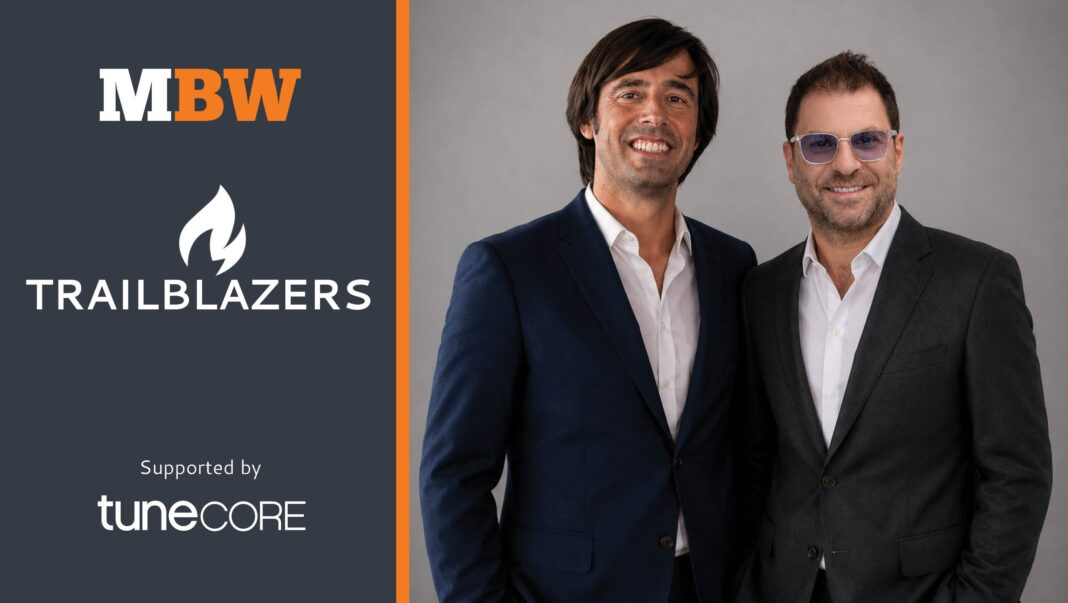
‘Arabic music is not a niche waiting to be discovered.’
Trailblazers is an MBW interview series that spotlights independent music entrepreneurs making waves – and building meaningful companies. Trailblazers is supported by TuneCore.
Eddy Maroun co-founded Anghami, the streaming service that in 2022 became what it billed as the first Arab technology company to list on Nasdaq.
His new company, IPNation, is setting out to buy the rights behind some of the Arab world’s most iconic songs.
Launched in August and headquartered in the UAE, IPNation describes itself as “the first investment platform dedicated exclusively to Arabic music catalogs and entertainment intellectual property (IP).” It has set a target investment size of USD $100 million.
Maroun, IPNation’s Chairman and Chief Innovation Officer, co-founded the company with its CEO, Jose Maria Dot, the former Chief Investment Officer of Abu Dhabi-listed Multiply Group (now 2PointZero).
IPNation launched with an initial commitment from New York-based Influence Media Partners, which is supported by strategic partnerships with funds and accounts managed by BlackRock. The size of Influence’s commitment hasn’t been disclosed, and IPNation has not yet announced its first acquisition.
The company plans to buy masters, publishing, and name, image, and likeness (NIL) rights from across the Middle East and North Africa (MENA). According to its website, it is looking to invest in 10–20 catalogs, with ticket sizes of between $2 million and $10 million.
Maroun tells MBW that IPNation is targeting “iconic, mature catalogs with typically five years of stabilized royalties,” via structures ranging from full acquisitions to minority stakes, artist buy-backs, and royalty-backed financing.
“The common denominator is not age,” he says. “It is cultural weight, predictable cash generation, and meaningful potential for a second life.”
That “second life” sits at the center of IPNation’s pitch. Beyond acquisitions, the company says it will develop the IP it buys into “multi-format entertainment franchises” spanning immersive experiences, live shows, film, documentaries, merchandise, gaming, licensing, “AI-powered derivatives,” and next-generation fan engagement.
“WE ARE NOT LOOKING TO BUY A CATALOG, PUT IT ON A SHELF, AND COLLECT ROYALTIES.”
IPNation’s launch comes as MENA’s recorded music market continues to outpace most of the world.
According to IFPI’s Global Music Report 2026, MENA recorded music revenues grew 15.2% YoY in 2025, making MENA the joint second-fastest-growing region globally, level with Sub-Saharan Africa and behind only Latin America (+17.1%). Global revenues grew 6.4% to $31.7 billion.
In 2024, MENA was the world’s fastest-growing region, with revenues up 22.8% YoY. Streaming accounted for 97.5% of the region’s recorded music revenues in 2025, per IFPI.
Maroun argues that investment in the region has so far followed new releases, not back catalog.
“There is very little focus and investment in catalogs – all resources are focused on frontline releases,” he says, adding that rights ownership and management “is often fragmented, metadata can be inconsistent, collections are incomplete, and licensing can be difficult to navigate.”
“ARABIC MUSIC IS NOT A NICHE WAITING TO BE DISCOVERED. IT IS AN ESTABLISHED CULTURAL ASSET WAITING TO BE ACTIVATED AT SCALE.”
IPNation won’t have the field to itself: Reservoir Media’s Abu Dhabi-based joint venture partner PopArabia has been acquiring Arabic music rights since 2020.
In April, PopArabia acquired MENA label and distributor Viral Wave, whose operations are based in Cairo; Reservoir says PopArabia now administers a combined catalog of nearly 100,000 Arabic songs.
Maroun says IPNation’s differentiation is “the combination of focus, optimization, and innovation.”
He co-founded Anghami with Elie Habib in Beirut in 2012. As co-CEO, he took the company public in February 2022 via a SPAC merger with Vistas Media Acquisition Company Inc.
In April 2024, Anghami completed a combination with OSN+, the video streaming service owned by OSN Group, which took a 55.45% stake. Habib became CEO, while Maroun remained on Anghami’s board.
In June, controlling shareholder OSN Streaming made a preliminary, non-binding proposal to take Anghami private at $3.39 per share.
Maroun says building Anghami showed him “how much untapped value existed in the rights and catalogs behind that music.”
IPNation’s backer has made big bets on music rights before: Influence Media, founded in 2019 and led by Founder and Co-Managing Partner Lylette Pizarro McLean, formed a $750 million music rights partnership with BlackRock Alternative Investors and Warner Music Group in 2022. Its portfolio includes rights from Future, Enrique Iglesias, and Blake Shelton.
In July, Influence agreed to acquire substantially all of the assets of Canadian rights company Anthem Entertainment for over $600 million, in collaboration with funds and accounts managed by affiliates of BlackRock. The deal is expected to close in Q4 2026.
Maroun says Influence gives IPNation access to “institutional investment discipline, highly respected global industry relationships, operational know-how, and proven success in catalog management.”
Here, Eddy Maroun explains what Anghami taught him about the value of Arabic music rights, what IPNation offers artists and estates, and why he believes the global industry is overlooking decades of iconic catalogs…
Credit: MOUTASEM PHOTOGRAPHY/Shutterstock
You co-founded Anghami and took it from a regional startup to the first Arab tech company to list on Nasdaq. With OSN now pursuing a potential take-private transaction, what are your biggest takeaways from that experience, and how did it shape the decision to build a rights platform?
Anghami taught me that building category-defining businesses in this region requires equal parts ambition, patience, and infrastructure. When we launched Anghami, our ambition was to transform how people across the Arab world discover, access, and experience music, while creating new opportunities for artists and the wider music industry. Anghami demonstrated about the potential of tech and media businesses built in this region with a focus on its deep culture.
“Anghami taught me that building category-defining businesses in this region requires equal parts ambition, patience, and infrastructure.”
Through that journey, I gained a deeper understanding of the opportunities across the entire music value chain. We helped build an ecosystem that connected millions of listeners with artists and their music, but I also saw how much untapped value existed in the rights and catalogs behind that music.
That helped shape the decision to build IPNation. While Anghami focused on transforming music discovery and consumption as a legit specialized service at scale with a focus on the local entertainment economy, IPNation represents an opportunity to build on the wider evolution of the industry by investing in, protecting, and growing the intellectual property behind the music. It’s about ensuring that iconic Arabic music continues to reach new audiences and generations, while creating long-term cultural and commercial value for artists, rights holders, and the region.
You’ve set a $100m target: what kind of catalogs are you looking to buy? Legacy estates, contemporary artists, or both?
We are focused on iconic, mature catalogs with typically five years of stabilized royalties, clear ownership, and enduring audience demand. That can include legacy estates, active artists, and catalogs held by labels or publishers. The common denominator is not age. It is cultural weight, predictable cash generation, and meaningful potential for a second life.
“We are focused on iconic, mature catalogs with typically five years of stabilized royalties, clear ownership, and enduring audience demand.”
We are targeting master recordings, publishing, and, where relevant, name, image, and likeness rights, through structures ranging from full or majority acquisitions to significant minority positions, artist buy-backs, and royalty-backed financing.
What does a good partnership with an artist or an estate look like from your side?
It starts with alignment and trust. We are not looking to buy a catalog, put it on a shelf, and collect royalties. We want artists and estates to feel that their IP has found a long-term home that will protect the legacy, respect the creative context, and introduce it to new generations across the region and beyond.
“We want artists and estates to feel that their IP has found a long-term home that will protect the legacy, respect the creative context, and introduce it to new generations across the region and beyond.”
Where an artist remains active, we prefer structures that preserve alignment and, where appropriate, co-ownership. From there, we agree a tailored value-creation plan that looks at improving distribution and collection, strengthening the catalog’s digital presence, and creatively developing collaborations, sync, film, live, sampling and remakes, or immersive experiences and brand extensions. The goal is a partnership in which the artist or estate gains liquidity and greater control, while continuing to participate in the future upside we create together.
Beyond the catalogs themselves, you’ve talked about live experiences, film, and gaming. Which of those excites you most, and where do you see the biggest opportunities?
It’s the ability to turn a catalog into a living cultural franchise, a full-fledged IP, rather than treat it as a static royalty stream. Film and documentary can reintroduce an artist’s story globally. Sync, samples, or remixes can place a song inside a new cultural moment.
“The biggest near-term opportunities are likely to be in areas where strong demand already exists, but execution has been fragmented.”
Collaborations can connect classics with younger listeners, while an immersive live avatar experience can make an icon present again. Gaming and emerging digital formats also matter, particularly as fan engagement becomes more interactive.
The biggest near-term opportunities are likely to be in areas where strong demand already exists, but execution has been fragmented. However, it is important to remember that it is not a one-size-fits-all; our approach will pursue each selectively, based on the character of the artist and the rights we control.
What differentiates IPNation from other music rights investors, in MENA and globally?
Our differentiation is the combination of focus, optimization, and innovation. IPNation is dedicated to iconic MENA music rights, rather than treating the region as an extension of a global catalog strategy or approaching it as a traditional label business.
“Influence Media adds global specialist expertise, processes, and industry relationships.”
Our team combines deep, long-standing relationships across the regional music ecosystem with a disciplined investment approach shaped by multi-billion-dollar transaction experience. We also manage rights actively, improving metadata, distribution, collection, and digital performance, then building a bespoke second-life plan around each catalog by investing in marketing, curation, development, and expansion.
Influence Media adds global specialist expertise, processes, and industry relationships. Together, that gives us the regional access to originate the right opportunities and the institutional capabilities to underwrite, protect, and grow them.
What’s the biggest challenge in the MENA music business right now?
Arabic music already has enormous audiences, but rights ownership and management is often fragmented, metadata can be inconsistent, collections are incomplete, and licensing can be difficult to navigate. There is very little focus and investment in catalogs – all resources are focused on frontline releases.
“Arabic music already has enormous audiences, but rights ownership and management is often fragmented, metadata can be inconsistent, collections are incomplete, and licensing can be difficult to navigate.”
The region’s regulatory direction is also improving. The region’s music market is among the fastest growing including the development of collective management organizations in the UAE and growing focus on IP frameworks across the GCC.
The next step is to connect that progress with professional rights administration, transparent data, and scaled catalog management. If we get those fundamentals right, capital can flow more confidently, and creators can capture a fairer share of the value they generate.
What’s the most overlooked opportunity in Arabic music that the wider global industry doesn’t see?
It is the depth of proven, cross-generational IP that already exists. Global conversations often focus on Arabic music as an emerging trend or on the next breakout artist similar to K-pop or Latin. That misses decades of iconic catalogs with loyal audiences across a 500 million-plus Arab population and a substantial global diaspora.
“Global conversations often focus on Arabic music as an emerging trend or on the next breakout artist similar to K-pop or Latin.”
Many of these works have never had the benefit of promoted and coordinated storytelling. Kanye West’s collab sample of the legendary Fairouz written by the iconic Rahbanis in All the Love became a global phenomenon. This is not about manufacturing demand; it is about making existing demand more visible and accessible, then giving timeless music new routes into global culture. Arabic music is not a niche waiting to be discovered. It is an established cultural asset waiting to be activated at scale.
What are your predictions for MENA over the next five years, and your ambitions for IPNation within it?
I expect MENA music to become a more structured, investable, and globally connected market. Streaming growth will continue to make audience demand visible and cross-continental, rights administration and collection will mature, and we will see more institutional capital, larger catalog transactions, and more sophisticated partnerships between artists, investors, brands, and entertainment companies.
“I expect MENA music to become a more structured, investable, and globally connected market.”
AI will also expand the ways catalogs can be protected and reimagined, while making authentic, culturally resonant IP even more valuable. Our ambition is for IPNation to become the region’s platform of scale for iconic music and IP: a trusted long-term home for artists and estates, a high-quality gateway for investors, and a bridge that takes Arabic music to larger and more diverse audiences.
If there were one thing you could change about the music business, what would it be and why?
If I could change one thing, I would advocate for less free and more paid-for music as a premium asset – ensuring better monetization for the whole ecosystem. Also, it would be to make ownership and payment radically clearer.
Too many creators still struggle to understand who controls which rights, where their music is being used, and whether all the value it generates is reaching them. Creativity will always be the heart of the music business, but a more lucrative and transparent rights infrastructure is what allows creativity to compound into lasting cultural and economic value.
Trailblazers is supported by TuneCore. TuneCore provides self-releasing artists with technology and services across distribution, publishing administration, and a range of promotional services. TuneCore is part of Believe.Music Business Worldwide
Get the daily email from CryptoNews that makes reading the news actually enjoyable. Join our mailing list to stay in the loop to stay informed, for free.