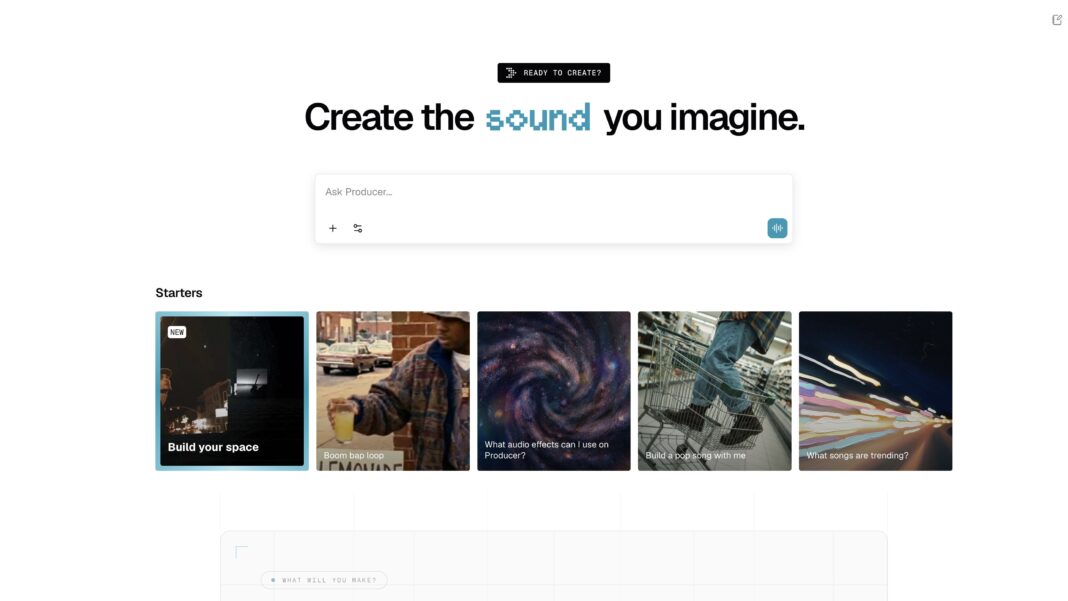
Google has acquired ProducerAI, the AI music creation platform formerly known as Riffusion, bringing the startup and its team into Google Labs.
The deal was announced on Tuesday (February 24) via a Google blog post from Elias Roman, Senior Director of Product Management at Google Labs, who described ProducerAI as “a creative collaborator” that allows users to “turn imagination into dynamic, comprehensive songs”.
ProducerAI’s full team appears to be joining Google across both Google Labs and Google DeepMind, according to a LinkedIn post from ProducerAI exec Kendall Rankin.
The news arrives just a week after Google launched Lyria 3, which it has described as its ‘most advanced’ generative AI music model to date, in its Gemini chatbot app, where it allows users to create AI-generated tracks from text prompts or images.
Under Google, ProducerAI now runs on a preview version of Lyria 3 for music generation, Gemini for its chat interface, Google’s Nano Banana model for album art, and Veo for AI-powered music videos, with all outputs embedded with Google’s SynthID watermark for identifying AI-generated content.
Seth Forsgren, co-founder and CEO of ProducerAI, told The Verge the team is “just scratching the surface of what these models are going to be able to do once we harness everything that Google brings to the table.”
Roman told the outlet the key difference between ProducerAI and other AI music-making platforms is the conversational back-and-forth with the platform’s built-in agent: “It’s not a tool that you put in your prompt, roll the slot machine, and something will come out. The reality is that’s not how good music is made… and ProducerAI was really made for the back-and-forths that play out over time.”
ProducerAI was founded by Seth Forsgren and Hayk Martiros, who originally launched the platform as Riffusion as an open-source hobby project that went viral in December 2022
The startup raised a $4 million seed round in October 2023 led by Greycroft, with participation from South Park Commons and Sky9, and brought on The Chainsmokers as advisors. The platform launched in July 2025 as a successor to Riffusion, initially using the startup’s own AI model.
“We are so grateful to see how this platform continues to evolve. It’s truly crafted around the musician’s experience. The founders are incredibly technical, but natively musicians, and understand the nuances of what makes a platform truly be an additive tool in the creation process.”
Alex Pall, The Chainsmokers
Alex Pall of The Chainsmokers said: “We are so grateful to see how this platform continues to evolve. It’s truly crafted around the musician’s experience. The founders are incredibly technical, but natively musicians, and understand the nuances of what makes a platform truly be an additive tool in the creation process.”
Google said it has also been working with artist partners through its Music AI Sandbox — a suite of experimental tools for professional musicians developed with DeepMind and YouTube.
Grammy-winning artist Wyclef Jean is among those who have used Lyria as a creative tool during the development of his music:
“As we continue to build ProducerAI at Google, we will be laser-focused on creative control for artists, including through features like Spaces, which allows artists to use natural language to create completely new instruments, effects, and more,” said Roman in the blog post on Tuesday.
The acquisition comes as Google continues to pursue AI-focused deals. The tech giant recently brought in the CEO and top engineers from voice AI startup Hume AI via a licensing deal.
ProducerAI enters the Google stable as a comparatively small player in a generative AI music market increasingly defined by deep pockets and legal risk.
Suno, one of the most prominent players in the space, closed a $250 million Series C at a $2.45 billion valuation in November, reporting $200 million in annual revenue. Suno settled its copyright lawsuit with Warner Music Group in late November, striking a licensing partnership, though it still faces infringement suits from Sony Music and Universal Music Group, as well as European music rights orgs, including Denmark’s Koda and Germany’s GEMA.
On Monday, MBW reported that a coalition of artist representatives published an open letter calling on the music community to “Say No to Suno”, describing the platform as a “brazen smash and grab” that “floods platforms with AI slop and dilutes the royalty pools of legitimate artists”.
Google has not specified how Lyria 3 was trained, but said in a blog post on Wednesday (February 18) it has sought to “develop this technology responsibly in collaboration with the music community” and has “been very mindful of copyright and partner agreements” in training the model.
MBW understands that to mean the training for Lyria 3 uses music that YouTube and its parent company, Google, “have the right to use” under their “terms of service, partner agreements, and applicable law”.Music Business Worldwide
